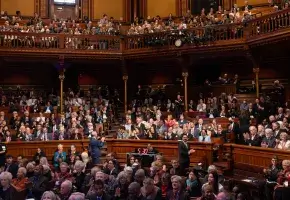
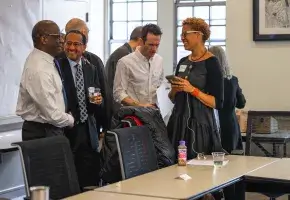
Academy members and guests attended a matinee performance of Robert Glaudini's The Poison Tree, in its world premiere at the Mark Taper Forum. After the show, they adjourned to the Dorothy Chandler Pavilion for dinner and the Stated Meeting, presided over by Western Center Cochair Jack W. Peltason.
The twenty-first-century information sciences will allow us to communicate information and compute at unprecedented speeds. By 2029, for example, we should be able to build computers, in quantity, that are a million times more powerful than the personal computers of today.
The Academy's first new members were elected in 1781 and today the Academy announced the members elected in 2025. The individuals elected were recognized for excellence in various fields and professions and are invited to join the Academy in connecting across disciplines and divides to advance the common good.
Danielle Allen writes about how Facebook is weakening our democratic institutions and what can be done to rebuild them. For solutions, she draws on recommendations in the Our Common Purpose report issued by the Academy Commission she cochaired.
The Commission on the Practice of Democratic Citizenship will work across disciplines to develop an understanding of how native born and newly arrived Americans engage with the institutions of their democracy, and how they exercise their rights and responsibilities as citizens.
The Global Security and International Affairs program fosters knowledge and promotes innovative and evidence-based policies to address crucial issues affecting the international community. It draws on the expertise of a broad range of policymakers, practitioners, and scholars to design and lead projects engaging with the pressing strategic, development, and moral questions that underpin relations among people, communities, and states worldwide.
The Academy holds in-person and virtual events that bring members, Affiliates, and others in their communities together to explore topics of national and global concern. Academy President David W. Oxtoby provided opening remarks for most of the meetings in 2021 and 2022.
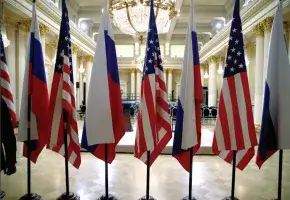
A new publication from the American Academy of Arts & Sciences and the Russian Academy of Sciences is released. Its purpose is to inform policymakers who will shape the relative safety or danger of the future international nuclear environment.
Danielle Allen responds to new national test results from the National Assessment of Educational Progress (NAEP) which revealed a further decline in students’ knowledge in U.S. history and civics.
In today’s high-tech and hyperconnected world, threats from insiders go far beyond leakers and lone-wolf shooters. How can we better protect against the enemy within, no matter what it is that needs to be protected?
The Academy’s project on the Alternative Energy Future is working to identify societal barriers to the widespread adoption of new energy technologies and to assess how these barriers might be better understood and managed.
A bipartisan commission issues 31 recommendations to strengthen America’s institutions and civic culture to help a nation in crisis emerge with a stronger democracy.
Building on America’s 250-year-old commitment to knowledge, the American Academy of Arts & Sciences announces the leaders in academia, the arts, industry, journalism, philanthropy, policy, research, and science elected in 2026.