Utility navigation

  • Dædalus
  • Archives
  • Give
  • Login

Main navigation

  • Our Work
    • Explore by Topic
      • Arts & Humanities
      • Democracy & Justice
      • Education
      • Energy & Environment
      • Global Affairs
      • Science & Technology
    • View
      • Projects
      • Publications
  • Members
  • News
  • Events
  • Get Involved
  • About

Main navigation

  • Our Work
    • Explore by Topic
      • Arts & Humanities
      • Democracy & Justice
      • Education
      • Energy & Environment
      • Global Affairs
      • Science & Technology
    • View
      • Projects
      • Publications
  • Members
    • Member Directory
    • Magazine: The Bulletin
    • Local Committees
  • News
  • Events
  • Get Involved
  • About
    • Governance
      • Board of Directors
      • Council
      • Trust
      • Committees
      • President
    • Staff
    • Affiliates
    • Prizes
      • Amory
      • Distinguished Leadership
      • Don M. Randel Humanistic Studies
      • Emerson-Thoreau
      • Excellence in Public Policy
      • Founders
      • Rumford
      • Sarton History of Science
      • Sarton Poetry
      • Scholar-Patriot
      • Talcott Parsons
    • Fellowships
    • Location
    • History
    • Advisors
      • Education
      • The Humanities, Arts, and Culture
      • Science, Engineering, and Technology

Footer

  • Daedalus
  • Login
  • Archives
  • Give
  • Careers
  • Contact
  • Private Events

136 Irving Street
Cambridge, MA 02138

Social Media

  • Facebook
  • LinkedIn
  • YouTube
Search results for

“funding”

Search

  • All (650)
  • Events (6)
  • (-) News (270)
  • People (86)
  • Projects (28)
  • Publications (260)
Bulletin
|
Feb 19, 2021

Challenges for International Scientific Partnerships

Global challenges, like the COVID-19 pandemic, underscore the value of international coordination and collaboration. In the case of pandemics, this need comes into play not only in managing and mitigating the spread of the disease, but also in the development of treatment therapies and vaccines. Indeed, the first COVID-19 vaccine approved by the U.S. Federal Drug Administration in December 2020 arose from an international collaboration between U.S. and German-based biotech companies, each led by immigrants from Greece and Turkey, respectively.
Press Release
|
Apr 19, 2021

Academy Receives $1M Grant from the Rockefeller Brothers Fund to Strengthen Democracy

The American Academy of Arts & Sciences has received a $1 million grant from the Rockefeller Brothers Fund to advance the recommendations in Our Common Purpose from ideas to implementation.
Bulletin
|
Dec 1, 2023

American Institutions, Society & the Public Good

The American Academy of Arts and Sciences was founded by visionaries who foresaw that the nascent republic would benefit from the expertise of learned citizens to guide its development, health, and integrity through whatever challenges may arise.
Bulletin
|
Feb 10, 2020

New Federal Program Among Far-Ranging Achievements of the Commission on Language Learning

When President Donald Trump signed the 2020 National Defense Authorization Act (NDAA) in December 2019, the World Language Advancement and Readiness Act became the first piece of federal legislation in a generation that addressed the language needs of the nation.
Bulletin
|
Jul 28, 2025

Cultural Spaces and Their Communities

On March 30, 2025, the Academy’s Chicago Committee hosted an event for members and guests that explored the role of cultural organizations and the communities they serve. The program featured Leah A. Dickerman (The Museum of Modern Art) and Oskar Eustis (The Public Theater) in conversation with Academy President Laurie L. Patton. An edited transcript of the program follows.
Bulletin
|
Aug 20, 2015

Causes of Campus Calm: Scaling China's Ivory Tower

Elizabeth J. Perry explains the means by which the Chinese Communist party-state maintains campus calm, despite the many unpopular and potentially unsettling higher education reforms.
Press Release
|
May 26, 2005

Universal Education is Achievable and Affordable, Academy Study Concludes

Universal, high-quality primary and secondary education is achievable – and well within the ability of wealthy nations to fund – by the middle of the 21st century.
In the News
|
Feb 28, 2017

Language Study as a National Imperative

The Academy's Commission on Language Learning makes the case for increasing foreign language learning capacity in a political climate that's increasingly anti-global.
Source
Inside Higher Ed
Academy Article
|
Jan 9, 2020

New Federal Program Among the Far-Ranging Achievements of the Commission on Language Learning

With the signing of the 2020 National Defense Authorization Act (NDAA), the World Language Advancement and Readiness Act became the first piece of federal legislation in a generation to address the language needs of the nation. This act is the most high-profile achievement of Academy’s Commission on Language Learning since it released its final report in 2017.
Academy Article
|
Nov 22, 2022

Democracy was a Big Winner in the Midterms

Across the country, state and local referenda gave voters a chance to enact the recommendations in Our Common Purpose. Almost everywhere, they did just that, supporting ballot measures to expand ranked-choice voting, increase access to early voting, and improve transparency around election funding.
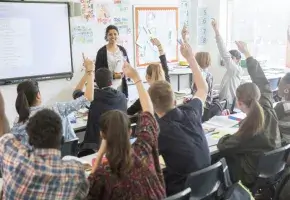
A professor stands at the front of an amphitheater.
Academy Article
|
Sep 15, 2025

New $1.5 Million Challenge to Modernize Academic Hiring and Promoting

The Academy, in partnership with the Open Research Community Accelerator (ORCA) and the Aspen Institute Science & Society Program, launched the Modernizing Academic Appointment and Advancement (MA3) Challenge. The initiative invites U.S. colleges and universities to transform academic hiring, review, promotion, and tenure practices.
Bulletin
|
Apr 24, 2026

Modernizing Academic Appointment and Advancement

Anti-intellectualism is on the rise, fueled in part by attacks on institutions of higher education. As a result, the public has begun to question the role these institutions play in society and whether they still provide the value they once did. For decades, colleges and universities have claimed to advance the public good, pointing to their research contributions as evidence of their value and their continued need for public support. Their internal processes, however, do not always reflect their commitments.
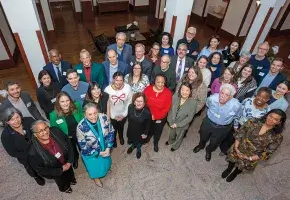
A group of 37 adults in business casual attire pose together for a photo taken from an elevated angle with everyone smiling up at the camera. The subjects in the photo are standing in a space with tiled flooring and white columns with wooden trim.
Academy Article
|
Apr 29, 2026

Takeaways: Education and Healthcare Employer Partnerships in Boston

What are the lessons learned when community college leaders, researchers, area employers, policymakers and philanthropists get together to discuss how to provide postsecondary students with the skills they need for meaningful employment?
Press Release
|
Nov 9, 2020

Exploring the Humanities in American Life

In a new release today, the American Academy reports on the first broad national survey on the humanities, which asked Americans about their engagement in a variety of humanistic activities, as well as their beliefs about the personal, societal, and economic benefits of the humanities.
Bulletin
|
Aug 1, 2014

Dædalus Examines “The Invention of Courts”

What challenges confront U.S. courts as democratic institutions in the twenty-first century? And what does the changing role of courts teach us about our conceptions of justice? The Summer 2014 issue of Dædalus explores the complex shifts occurring in U.S. courts and the implications for the citizens that rely on them.
Bulletin
|
Mar 1, 2000

Goals of "2001 and Beyond: A Plan for Renewal"

Bulletin
|
Jun 1, 2015

The Invention of Courts

Judith Resnik, Jonathan Lippman, Carol S. Steiker, Susan S. Silbey, Jamal Greene, and Linda Greenhouse participated in a conversation on the function of courts in the United States.
Bulletin
|
Dec 10, 2025

Highlights of Programmatic Impact

The Academy’s new strategic framework presents four animating principles and seven strategies that are designed to ensure that the Academy continues to produce high-quality, interdisciplinary work that addresses urgent societal challenges. In 2025, the Academy’s programmatic work laid the groundwork for new projects and initiatives that will implement this framework and built on ongoing efforts to increase impact and raise the visibility of the institution with external audiences. These audiences include policymakers at the federal, state, and local level; leaders in philanthropy, higher education, nonprofit organizations, and business; scholars and students; advocacy groups; professional groups and practitioners; and the public.
Press Release
|
May 16, 2022

The Humanities Retain a Substantial Role in the Nation’s High Schools

High school students continue to engage with the humanities (English, languages, and history) at a high rate, albeit with evidence of some troubling racial disparities, according to new findings from the American Academy of Arts & Sciences’ Humanities Indicators.
Bulletin
|
Feb 20, 2026

What’s Next for Cultural Organizations? Academy Roundtables Discuss Current Challenges and Future Needs

Cultural institutions across the United States—regardless of type or size—are facing unprecedented uncertainty, which is challenging long-standing models for communicating the value of arts and culture, for supporting these institutions, and for collaborating across the sector. To help address this uncertainty, the Academy held three virtual roundtable discussions in the fall of 2025 that brought together leaders from the arts and culture sector to reflect on these challenges and begin to outline strategies to move forward. To encourage open and candid dialogue, the discussions were held under the Chatham House Rule, so neither participants nor their comments can be identified in any materials related to the roundtables.

Pagination

  • Previous page ←
  • 4 of 14
  • Next page →

136 Irving Street
Cambridge, MA 02138

617-576-5000

VEHICLE ENTRANCE

200 Beacon Street
Somerville, MA 02143

Main navigation

  • Our Work
  • Members
  • News
  • Events
  • Get Involved
  • About

Footer

  • Daedalus
  • Login
  • Archives
  • Give
  • Careers
  • Contact
  • Private Events

Social Media

  • Facebook
  • LinkedIn
  • YouTube
© 2026

American Academy of Arts & Sciences  |  Web Policy