By Dædalus Editorial
Continued progress in artificial intelligence, its expanding usefulness in science, and its contributions to landmark advances suggest that we may have entered a new era of AI for science.
The breakthroughs so far—such as predicting the structure of practically every known protein, with profound implications for our understanding of biology, health, and the treatment of disease—are notable not only for what was achieved but also how it was achieved and what that suggests for scientific progress.
This special double issue of Dædalus, edited by James Manyika (SVP at Google-Alphabet and also President for Research, Labs, Tech & Society), poses the question: What is the future of scientific discovery in this new age of AI?
Thirty-three scientists responded. Bringing perspectives from life sciences and medicine, cognitive science and neuroscience, the physical and earth sciences, chemistry and materials science, computer science, mathematics and the social sciences—they draw on their work at the frontier of AI and science.
The authors write with an eye to the future, not just the present. They explore what is being achieved and what possibilities lie ahead; examine AI’s limitations and efforts to move forward; and investigate the larger implications of AI-assisted science—on how science is done, the role of the scientist, and the scientific method, as well as the challenges and complexities involved.
The authors together exemplify a long-standing bidirectional relationship: AI advancing science, while science advances AI. Where that relationship will take us—A golden age of discovery? New scientist-machine collaborations? Autonomous labs? Discoveries without human understanding?—is a future we are only beginning to imagine, and one we must also shape if the beneficial possibilities are to be realized.
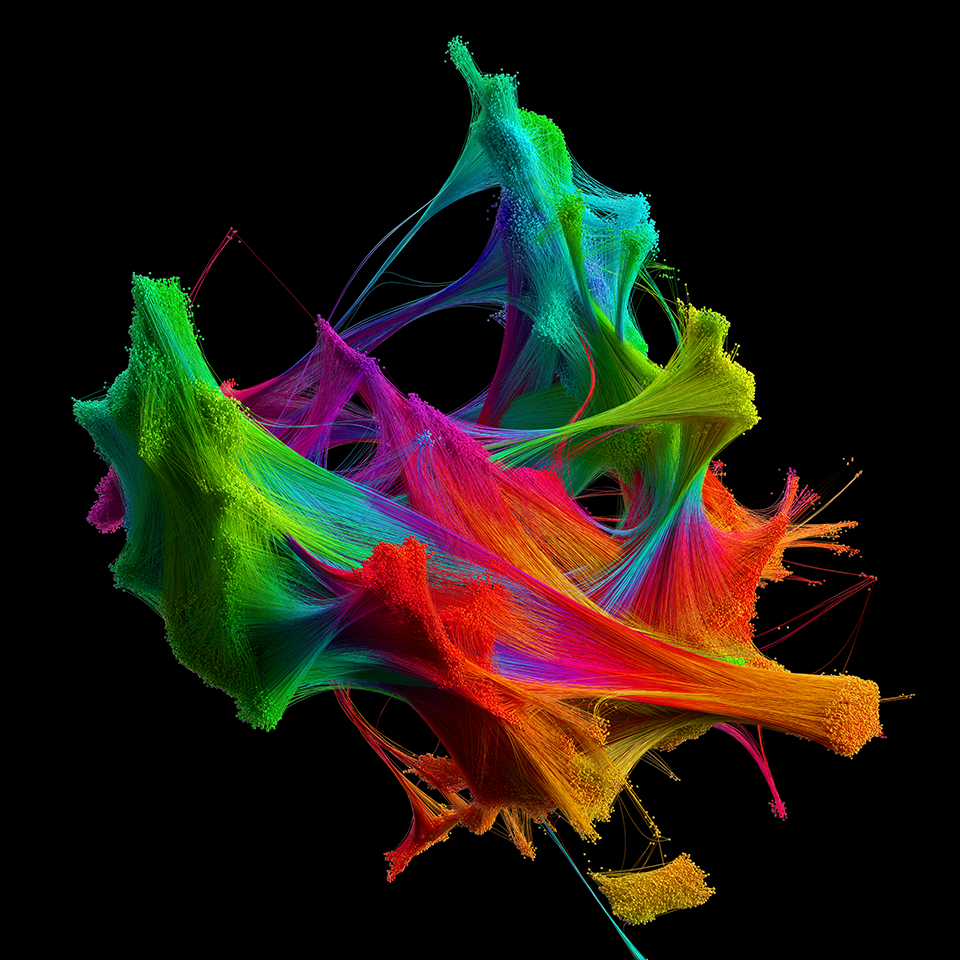
Mapping Four Decades of AI Research: A UMAP Sculpture across Three Dædalus Issues
What does it look like when you compress nearly forty years of humanity’s most rigorous thinking about artificial intelligence into a single form?
This work is a UMAP (Uniform Manifold Approximation and Projection) rendering of every word across three landmark issues of Dædalus—winter 1988, “Artificial Intelligence”; spring 2022, “AI & Society”; and winter/spring 2026, “AI & Science”—based on similarity clustering (six-dimensional: x, y, z and red, green, blue colorizing).
Three distinct moments when the Academy convened leading minds to take stock of where AI stands and where it’s heading. The resulting image is not an illustration. It is a sculpture, shaped not by chisel or clay, but by the geometry of language itself, compressed through machine intelligence into visible form.
In 1988, the conversation was intimate and philosophical. Seymour Papert, Daniel Dennett, and Sherry Turkle debated whether machines could ever truly think. The vocabulary orbited the body: brains, neurons, perception, consciousness.
By 2022, the language had exploded outward. Fei-Fei Li, James Manyika, and Erik Brynjolfsson confronted what deep learning’s success meant for justice, labor, and democracy.
The 2026 issue reaches further still. Demis Hassabis describes AI as an instrument for understanding reality itself—from protein folding to the laws of physics. Yann LeCun argues for world models that move beyond language into abstract representation.
The UMAP reveals the filaments between these eras. Words like intelligence, learning, and human appear in all three, but their neighbors shift—from neuron in 1988, to equity in 2022, to prediction in 2026. The dense clusters are shared concerns; the long tendrils reaching into darkness are ideas unique to each moment.
When Brunelleschi carved perspective into architecture, or when Michelangelo released figures from marble, they were not simply making objects—they were making visible the invisible structures of their age. The Renaissance sculptors gave form to human proportion, divine geometry, and anatomical truth. Today, a parallel undertaking is quietly emerging: the sculpting of data itself into physical and immersive form, using machine intelligence as both material and collaborator.
This is what I have tried to pursue in my own practice—humbly, and with deep respect for what came before—treating vast archives of information not as abstract numbers but as raw matter waiting to reveal its hidden shape. It is, I believe, the beginning of a new sculptural movement: one in which the artist’s hand is guided by algorithms, in which the block of marble is replaced by multidimensional space, and in which what emerges is not a representation of the world but the actual structure of collective knowledge made tangible.
Three issues. Four decades. One continuous, expanding form.
–Refik Anadol
https://refikanadol.com
© 2026 by Refik Anadol; reprinted from Dædalus, “AI & Science: What Is the Future of Discovery?”
Contents of “AI & Science: What Is the Future of Discovery?”
Introductory Notes: On AI, Science & the Future of Discovery
James Manyika
In Dialogue: AI Pioneers on AI & Science
AI as the Ultimate Tool for Science: A Conversation with Demis Hassabis
Demis Hassabis & James Manyika
Learning Abstractions: A Conversation with Yann LeCun
Yann LeCun & James Manyika
AI in the Life Sciences & Physical Sciences
From Alchemy to AIchemy: On Matter, Minds & Tools
Alán Aspuru-Guzik
Unlocking Scientific Intuition & Reasoning at Digital Speed
Pushmeet Kohli
Beyond Representation: AI in Cellular Discovery
Charlotte Bunne & Aviv Regev
Building the Drug Discovery Engine of the Future with AI-Empowered Nodal Biology
Anna Greka
From Pixels to Minds: Mapping & Understanding the Brain with AI
Viren Jain & Jeff Lichtman
The Algorithmic Planet
Anna M. Michalak & John C. Platt
AI Reaches for the Stars
Stella S. R. Offner
The Science of AI & Developing AI for Science
Language Is Not All You Need . . . but Language, Probabilistic Programs & Bayesian Models of Cognition Will Get You Pretty Far
Joshua B. Tenenbaum
Knowledge-Centric AI for Scientific Discovery
Carla P. Gomes
Building an AI Polymath
Shirley Ho
How Do We Build AI to Push the Frontiers of Scientific Discovery?
Anima Anandkumar
Toward a Science of Intelligence: Unifying Physics, Neuroscience & AI
Surya Ganguli
Quantum + AI = Quantum AI
Maria Spiropulu & Hartmut Neven
The Social Science of AI for Science
The Future of AI-Facilitated Medicine
Eric J. Topol
The Role of AI in Drug Discovery in Africa
Kelly Chibale
Physics Is Different: Context, Culture & Craft in Effective AI for Physics
Tess Smidt
Thinking & Doing Science in the Age of AI
Alison Noble
Field Theory: AI as Social Science Question, Object & Tool
Alondra Nelson
Philosophy of Autonomous Science: Ten Questions for the Coming Age of Artificial Scientists
Mario Krenn & Heather Champion
Personal Briefs
Geometry-Informed AI for Scientific Discovery
Melanie Weber
Are Current AI Systems Unlocking Knowledge Discovery in Genomics?
Antonio Orvieto
AI & the Discovery of Molecules through Autonomous Laboratories
Connor Coley
Scaling Physics Intelligence for the Earth’s Subsurface
Gege Wen
AI & Ecology: From Tool to Transformation
Sara Beery
Making Automation Work for Social Scientists
M. J. Crockett
When AI Meets Art at the Scales of Science
Refik Anadol
“AI & Science: What Is the Future of Discovery?” is available on the Academy’s website. Dædalus is an open access publication. We invite you to share links to essays and to entire Dædalus volumes with friends, colleagues, and students.