The Academy typically holds events around the country and the world that bring members and others in their communities together. Although the COVID-19 pandemic suspended in-person events, the Academy continued to explore topics of national and global concern through a series of virtual activities. Academy President David W. Oxtoby provided opening remarks and moderated most of the virtual meetings and events.
In collaboration with the Ash Center at the Harvard Kennedy School, the Academy hosted a discussion on “Redistricting and Representation,” which included presentations by Gary King, Jamal Greene, and Moon Duchin. Chief Judge Patti Saris moderated the program.
Capitalist democracy needs rethinking and renewal. Our current political economic framework is fixated on GDP, individual achievement, and short-term profit, all the while heightening barriers to widespread prosperity. Faced with mounting climate crises and systemic discrimination, how can we reconfigure our systems to secure economic well-being for all? What steps must we take to ensure our new approaches are (and will remain) sustainable?
On February 6, 2018, Annette Gordon-Reed and Peter S. Onuf participated in a discussion on Jefferson, race, and democracy, drawing from their recent book, “Most Blessed of the Patriarchs”: Thomas Jefferson and the Empire of the Imagination.
Academy projects in Science, Engineering, and Technology seek to strengthen the capacity of science and engineering to improve the human condition. This goal has never been more important for the nation or for the world than it is today. Global challenges increasingly require collaboration across disciplinary, professional, and national boundaries. Likewise, rapid advances in information processing and transmission raise new issues for the management of scientific knowledge and for action on new discoveries.
The Academy’s 2017th Stated Meeting on February 11, 2015, featured members of the Catalyst Collaborative@MIT performing a staged reading of Mr g, a novel by Alan Lightman. Mr g is the story of creation as narrated by God (Mr g). In it, Mr g’s uncle Deva and aunt Penelope give him advice as he sets about creating the universe; he also spars with a Satan-like character about various ethical and philosophical issues raised by his creation, especially when intelligent life emerges.
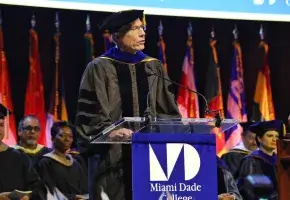
Mark S. Schlissel, Mary Sue Coleman, Patrick Doyle, M. Roy Wilson, and Lou Anna K. Simon participated in a discussion at the University of Michigan about public research universities and their role in serving the public interest in Michigan.
Neal Lane and Norman Augustine, cochairs of the Academy project on New Models for U.S. Science and Technology Policy, discuss the project’s latest report on the perils of complacency and how the U.S. can compete with China.
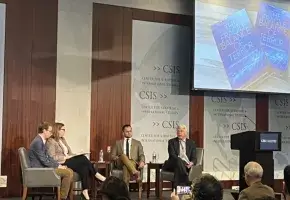
The Academy and the Center for Strategic and International Studies launched a new book -- The Fragile Balance of Terror: Deterrence in the Nuclear Age -- at a cohosted event in Washington D.C. featuring one of the volume's editors and multiple authors.
How did music in the twentieth century both influence and reflect American culture? The Fall 2013 issue of Dædalus examines how music—in Hollywood films, in concert halls, in private homes and public spaces—helped shape our modern selves.
At a Capitol Hill briefing today in conjunction with the release of three new policy monographs, experts outlined the current state of U.S. and foreign space policy and encouraged the Administration to set a clear direction that advances the country’s national security, civilian, and commercial interests in space.
The humanities are anomalous in their focus on academe as being “the one true career path” for students, Robert Townsend said, which is why he feels he has to defend the importance of career diversity.
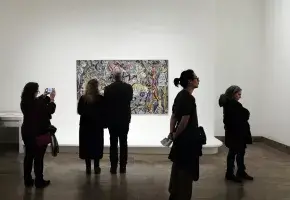
In updates released this morning, the American Academy's Humanities Indicators report that visits to historic sites, museums, and art galleries are on the rise in recent years.