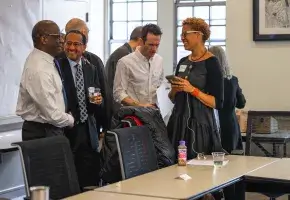
Free speech makes no distinction about quality; academic freedom does. Are all opinions equally valid in a university classroom? Joan Wallach Scott speaks about academic freedom after accepting the Talcott Parsons Prize.
As part of the 2013 Induction weekend, Ken Burns (President of Florentine Films) and Ernest J. Moniz (U.S. Secretary of Energy) spoke about the challenges and opportunities for the arts and the sciences.
A bipartisan commission issues 31 recommendations to strengthen America’s institutions and civic culture to help a nation in crisis emerge with a stronger democracy.
Building on America’s 250-year-old commitment to knowledge, the American Academy of Arts & Sciences announces the leaders in academia, the arts, industry, journalism, philanthropy, policy, research, and science elected in 2026.
In a forum essay, the HULA team (Danielle Allen, Maggie Schein, Christopher Pupik Dean, and David Kidd) describes its work, which start in the education sector but are now being extended to public humanities projects.
We know what a novel is, but can we say the same about the novel? The Winter 2021 issue of Dædalus “On the Novel,” guest-edited by Michael Wood, features fourteen essays that, rather than surveying or summarizing the fate of the novel, offer remarkable insights into the behavior of this versatile literary form, glimpses of where and what it has been and where it may go in the future.
The humanities are anomalous in their focus on academe as being “the one true career path” for students, Robert Townsend said, which is why he feels he has to defend the importance of career diversity.
The opening program of the 2022 Induction weekend featured a conversation between David M. Rubenstein, Co-Founder and Co-Chairman of The Carlyle Group, and cellist Yo-Yo Ma that explored the meaning and honor of Academy membership, the power and universality of music, and the importance of the arts, culture, and education, among other topics. An edited version of their conversation follows.
Building on the Academy’s commitment to the vital role that education and knowledge development play in our nation and world, the program area engages scholars and practitioners from a range of fields and disciplines to inform policies and practices that support high-quality, educational opportunities for all Americans.
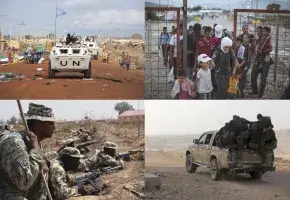
Civil wars can give rise to major threats to international stability, including transnational terrorism, pandemics, mass migration and refugee flows, and regional instability. Particularly serious concerns include the ways that civil conflict can contribute to the emergence of infectious diseases, undermine efforts to respond to pandemics – such as through vaccine distribution – and generate transnational terrorism with a global reach.