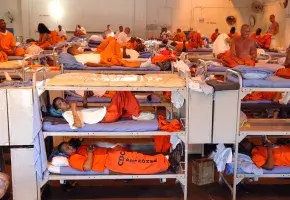
This study examined the scope of mass incarceration, its political significance, and its social impacts, weighing the concerns about crime control, rehabilitation, and more fundamental issues of social justice.
The Commission on Language Learning examined the current state of language education, projected what the nation’s education needs would be in the future, and offered recommendations for ways to meet those needs.
This study examined two mechanisms that allow for interchange between science and society: governmental science policy (often involving the participation of "scientist administrators") and scientists’ voluntary public-interest associations. The resulting book also looked at the activities of citizen-scientists who have organized themselves to promote the welfare of society.
In 1977, nearly twenty-five years after the U.S. Supreme Court’s 1954 Brown v. Board of Education decision found that “separate educational facilities are inherently unequal,” the aftershocks were still affecting American society. The Academy convened an interdisciplinary study group to examine the post-Brown urban school integration experience and to consider solutions to ongoing education inequality in American classrooms.
IIASA was formed in 1972 to provide a venue for collaboration between Western and Eastern bloc scientists on non-military matters, such as global energy needs, environmental change, and human health concerns.
In the 1960s, the United States developed a national system of social programs based on President Lyndon B. Johnson’s 1964 declaration of “unconditional war on poverty.” In 1966, the Academy convened a series of seminars on the many components of poverty.
This study examined the political and technical aspects of missile defenses, as well as the implications of the Intermediate-Range Nuclear Forces Agreement and the U.S. Strategic Defense Initiative.
The Academy convened a group of business people, public officials, and scholars from the physical sciences, social sciences, and humanities to discuss changing expectations for the future of society and culture.
This Academy-organized symposium brought together more than 30 scientists, scholars and public officials, from developed and developing nations, to discuss how social values do and should influence technology choice by nations and by groups of nations.
A study group composed of policy figures, military experts, and policy analysts studied such issues as the technical and political aspects of the U.S. and Soviet command and control systems over nuclear forces; the devolution and delegation of authority to use nuclear weapons; and the synergistic effects of U.S. and Soviet actions during a crisis.
German and American scholars met in three working groups to address admissions policy, absorption of immigrants, and policies that receiving and sending countries might adopt together to reduce the increasing numbers of refugees and migrants. This study resulted in five volumes comparing migration in the United States and Germany.
The Academy was instrumental in the establishment in 1970 of the International Centre of Insect Physiology and Ecology (ICIPE) in Nairobi, Kenya. The goal of the ICIPE is to develop more effective and less dangerous pesticides through a greater understanding of insect biology.
After World War II, the social sciences operated in a changed field, particularly in terms of their relations to the polity and the economy. This study examined whether the social sciences can credibly claim to perform an impartial role and how to maintain ethical integrity in social science scholarship.
In 1990, the Academy co-sponsored an interdisciplinary symposium focused on trends in current scholarship on homelessness. The resulting publication critically examined the shortcomings of the research into the causes of homelessness and addressed barriers to remedying this social problem.
Human diversity is an enormous cultural and biological resource and a source of social and political tension. The Academy convened a group of scholars to address the controversy over the relative roles of genetics and environment in determining human capacities and behavior.
This study compared France and the United States’ immigration policies, race relations, and political institutions. It looked at how both countries educate and house immigrants and analyzed the political and legal implications of integration, marginalization, and discrimination in each country.
With new surgical techniques, like heart transplants, becoming indispensable tools in prolonging human life, the issue of human experimentation became a matter of increasing public interest. The Academy created an interdisciplinary working group to study the ethics of human experimentation, and the working group’s papers were initially published in Dædalus in 1969.
Genocide in Rwanda, instability in the Middle East, anarchy on the Internet—insecurities abound. But do they occur "naturally," or are they, as this path-breaking volume suggests, cultural and social productions?
In 1969, the American Council of Learned Societies, of which the Academy is a founding member, convened its annual meeting to examine confrontation and challenges to the value of scholarship in society, inspired by the dissident rebellions at institutions of higher education in 1968.
The Academy co-sponsored a workshop to explore the feasibility of the United States and the Soviet Union agreeing to halt production of the radioactive, warhead-boosting agent tritium and to pace steady, significant reductions in their arsenals at the relatively rapid rate of tritium’s decay – the so-called “tritium factor.”