Deterrence and New Nuclear States
This initiative explored challenges created by “new” nuclear weapons states and produced the publication, The Fragile Balance of Terror: Deterrence in the Nuclear Age, which explores the implications of "new" nuclear states, such as North Korea; potential proliferators, such as Iran, Japan, Saudi Arabia, South Korea, and Turkey; and de facto nuclear weapons states, including India, Israel, and Pakistan.
The Fragile Balance of Terror:
Building on the Academy’s long history of studies on arms control, this work produced an edited volume of innovative and policy-relevant essays on challenges created by the emergence of “new” nuclear weapons states such as North Korea, and potential proliferators, such as Iran.
The volume, The Fragile Balance of Terror: Deterrence in the Nuclear Age, explores de facto nuclear weapons states, including India, Pakistan, and Israel, that operate outside of any established multilateral nuclear frameworks such as the Nuclear Non-Proliferation Treaty and the Nuclear Suppliers Group.
Chapters commissioned for the edited volume explore a range of themes, including emerging technologies and crisis stability; social media and crisis dynamics; multipolar nuclear interactions; and how we should define when a state “becomes” a nuclear weapons state.
Project leaders Scott D. Sagan and Vipin Narang edited the volume and contributed to it. The other authors are Giles David Arceneaux, Mark S. Bell, Christopher Clary, Peter D. Feaver, Jeffrey Lewis, Rose McDermott, Nicholas L. Miller, Ankit Panda, Caitlin Talmadge, Heather Williams, and Amy Zegart. The book is available online and in print.
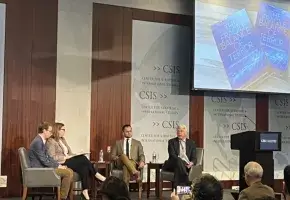
Events accompanying the release of The Fragile Balance of Terror: Deterrence in the Nuclear Age helped the book reach nuclear policymakers (primarily in the United States) and academic centers and think tanks with a specific focus on nuclear studies.
The book was part of the Meeting the Challenges of the New Nuclear Age project, which had a first phase (chaired by Robert Legvold and Christopher Chyba) exploring security dynamics emerging from nuclear relations among three main players: the United States, Russia, and China. The volume, The Fragile Balance of Terror: Deterrence in the Nuclear Age emerged in the second phase in recognition of an increasingly complicate global security environment.
The work culminated in a 2025 meeting at Stanford University titled “The Future of Nuclear Deterrence.” The meeting was co-hosted by the Academy, Stanford’s Center for International Security and Cooperation (CISAC) and MIT’s Center for Nuclear Security Policy. During the meeting, participants developed research questions to guide the future of deterrence research. Topics included deterrence in a multi-peer environment, extended deterrence, biological threats, and the future of arms control.
People

Scott D. Sagan