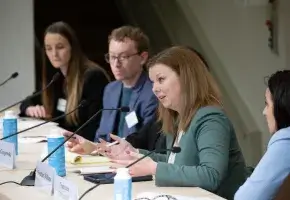
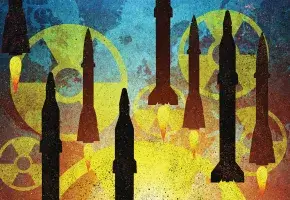
An event at the Academy explored and expanded upon essays in the new volume, The Fragile Balance of Terror: Deterrence in the Nuclear Age. Authors, other experts, and audience members in Cambridge and online considered how unpredictable leadership, domestic unrest, volatile states, and rapid technological advancements are changing the new nuclear era.
Local Program Committees and Representatives bring together communities of members to connect, explore topics of interest, and advise informally on Academy projects.
Scott D. Sagan, Joseph H. Felter, and Paul H. Wise discussed “A Collective Moral Awakening: Ethical Choices in War and Peace,” which is, in part, the subject of the Winter 2017 issue of Dædalus.
On October 11, 2014, the American Academy inducted its 234th class of Fellows and Foreign Honorary Members. The ceremony included presentations by new Fellows Ramamurti Shankar, Diana H. Wall, Sherry Turkle, Mary Kelley, and John W. Rogers, Jr.
The world is witnessing the emergence of new nuclear states that have acquired or are pursuing nuclear capabilities. These new nuclear actors pose significant threats to global security as they challenge the existing nuclear order and nonproliferation regime.
The closing program of the Academy’s 2024 Induction weekend featured a presentation by new member André Fenton about the science and stimuli of memory, followed by a conversation with incoming Academy President Laurie L. Patton. An edited transcript of the presentation and conversation follows.
As part of the Academy’s 2017 Induction weekend, Kathryn D. Sullivan discussed her experiences as a NASA astronaut and participated in a conversation with David M. Rubenstein.
Induction Weekend 2025 began with an Opening Celebration that featured the announcement of the new Legacy Recognition Honorees with a special message from John Legend, followed by a conversation between David M. Rubenstein, Co-Founder and Co-Chairman of The Carlyle Group, and Kenny Leon, Tony Award–winning stage and television director and new member of the Academy. An edited version of their conversation follows.
In November 2003 the people of the former Soviet state of Georgia forced a revolutionary change in leadership to establish a new government under President Mikhail Saakashvili. “Statehood and Security: Georgia after the Rose Revolution,” a new book from the American Academy, analyzes the security problems that confront this new government and the greater Caucasus region.