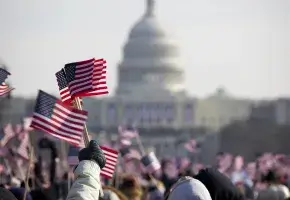
A poll sponsored by the Academy, and conducted by the Center for Public Opinion at UMass-Lowell, reveals displeasure with the state of American politics and receptivity to changes in how we elect Congressional representatives.
Academy members and guests attended a matinee performance of Robert Glaudini's The Poison Tree, in its world premiere at the Mark Taper Forum. After the show, they adjourned to the Dorothy Chandler Pavilion for dinner and the Stated Meeting, presided over by Western Center Cochair Jack W. Peltason.
Mark S. Schlissel, Mary Sue Coleman, Patrick Doyle, M. Roy Wilson, and Lou Anna K. Simon participated in a discussion at the University of Michigan about public research universities and their role in serving the public interest in Michigan.
The decennial census is the longest continuous scientific project in American history. It is also the largest applied social science project undertaken in this country.
On March 30, 2025, the Academy’s Chicago Committee hosted an event for members and guests that explored the role of cultural organizations and the communities they serve. The program featured Leah A. Dickerman (The Museum of Modern Art) and Oskar Eustis (The Public Theater) in conversation with Academy President Laurie L. Patton. An edited transcript of the program follows.
Much of the attention about the humanities in higher education tends to focus on four-year colleges and universities (and more specifically, on the declining number of students who major in the humanities). In recent years, the American Academy’s Humanities Indicators (HI) have been exploring the growing presence of the humanities in the community college sector.
Power in the workplace does not stop women’s exposure to sexual harassment. On the contrary, women with supervisory positions are harassed more than women employees. Daedalus authors Johanna Rickne and Olle Folke discuss the study addressed in their essay, “Sexual Harassment of Women Leaders.”
Peter Grant and B. Rosemary Grant present their research studying evolutionary processes in the Galápagos finches, followed by a conversation with Zackory Burns (Hellman Fellow in Science and Technology Policy).
A reflection on work done to advance democratic renewal rooted in the recommendations of the Our Common Purpose report, issued by a bipartisan Academy Commission in 2020.
A robust system of publication exchanges existed among societies in the 18th and 19th centuries. From this the Academy retains a selection of publications, such as an illustrated volume of the "Flora Batava".
Immigration is not only where the people come from, and why they come, and whether they are forced to come; it's also how and, in the long run, whether they are received.
Over the past year, the Humanities Indicators of the American Academy (http://humanitiesindicators.org) have been offering evidence for many of the urgent questions facing the humanities field.
Grants will support the Academy’s Humanities Indicators (www.HumanitiesIndicators.org), the first comprehensive collection of statistical data about the humanities in the United States.