A bipartisan commission issues 31 recommendations to strengthen America’s institutions and civic culture to help a nation in crisis emerge with a stronger democracy.
Building on America’s 250-year-old commitment to knowledge, the American Academy of Arts & Sciences announces the leaders in academia, the arts, industry, journalism, philanthropy, policy, research, and science elected in 2026.
Free speech makes no distinction about quality; academic freedom does. Are all opinions equally valid in a university classroom? Joan Wallach Scott speaks about academic freedom after accepting the Talcott Parsons Prize.
Projects in the Education program area inform policy and practice that support high-quality, educational opportunities for all Americans. Building on the Academy’s commitment to the vital role that education and knowledge development play in our nation and world, the program area engages scholars and practitioners from a range of fields and disciplines to examine the conditions that foster the creation, transfer, and preservation of knowledge throughout our society.
Civil wars can give rise to major threats to international stability, including transnational terrorism, pandemics, mass migration and refugee flows, and regional instability. Particularly serious concerns include the ways that civil conflict can contribute to the emergence of infectious diseases, undermine efforts to respond to pandemics – such as through vaccine distribution – and generate transnational terrorism with a global reach.
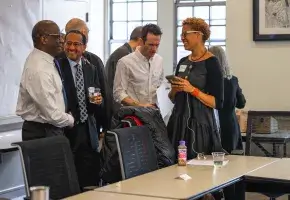
The Academy holds virtual events as well as in-person events around the country and the world that bring members, representatives of the Affiliates, and others together to explore topics of national and global concern.
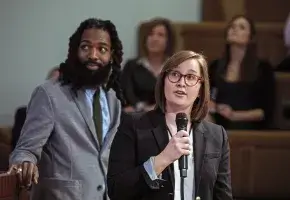
In early February, the Academy welcomed Americans from around the nation for a day-long convening on the practice of democratic citizenship. The event was a culmination of the extensive grassroots outreach and listening sessions that have been a hallmark of the work of the Academy’s Commission on the Practice of Democratic Citizenship.
Richard Saller, Elaine Treharne, Franco Moretti, Joshua Cohen, and Michael A. Keller discussed the humanities in the context of rapidly developing new technologies.
Judith Resnik, Jonathan Lippman, Carol S. Steiker, Susan S. Silbey, Jamal Greene, and Linda Greenhouse participated in a conversation on the function of courts in the United States.