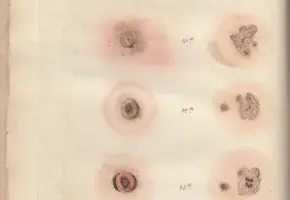
In 1783, a self-described“ Bostonian Member of the American Academy… at the request of another Member,” detailed the efforts of Reverend Doctor Cotton Mather to combat smallpox through inoculation...
On May 18, 1921, a Special Meeting was held at the House of the Academy at 28 Newbury Street in honor of Professor Albert Einstein of the Academy of Sciences in Berlin, during his first visit to the United States...
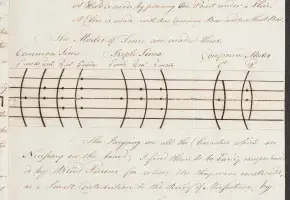
Benjamin Dearborn, an educator and inventor who was elected to the Academy in 1794, wrote to Academy president John Adams in August 1794, describing his design for a “Music Board” for the benefit of persons who are visually impaired...
At the 3rd Meeting of the Academy held on August 30, 1780, Academy members voted to appoint “a Committee to confer with the Reverend and Honorable Corporation of the University of Cambridge upon pursuing measures to procure an accurate observation of the Solar eclipse...”
A protracted debate within the Academy over Darwin’s Origin of Species began with a paper on Japanese flora presented by Asa Gray in 1858, leading to an exchange between Louis Agassiz and William Barton Rogers...
The cochairs of the Academy's Public Trust in Vaccines project discuss what research is needed to reverse the surge of outbreaks in vaccine-preventable diseases in the United States.
Stephanie Sy interviewed Daedalus contributor Joseph Felter about his article "Limiting Civilian Casualties as Part of a Winning Strategy: The Case for Courageous Restraint," co-authored with Jacob N. Shapiro.
Jeffrey G. Lewis and Scott D. Sagan published an op-ed adapted from their Daedalus article "The Nuclear Necessity Principle: Making U.S. Targeting Policy Conform with Ethics & the Laws of War."
While much of the conversation about the outcomes of college graduates focuses on their earnings, a new report from the American Academy’s Humanities Indicators offers a more expansive view of bachelor’s degree recipients’ experiences in the workforce and beyond.
At a Brown University event co-hosted with the American Academy of Arts and Sciences, panelists discussed the importance of partnering with community members and first responders and reducing stigma around addiction.
Scott D. Sagan published an op-ed later developed into his Daedalus essay "The Face of Battle without the Rules of War: Lessons from Red Horse & the Battle of the Little Bighorn."
Performance-enhancing drugs are transforming athletic competitions; bionic suits are aiding transportation of heavy goods by military personnel; and psychotropic pills are shifting the learning landscape of our schools. Understanding these changes will help us prepare for the future.
“Access to Justice,” the Winter 2019 issue of Dædalus, the Journal of the American Academy of Arts & Sciences, is a multidisciplinary exploration of the challenges, costs, and opportunities related to the crisis of limited civil legal services.
Access to justice is a “stunningly invisible issue given its importance in the country.” The latest issue of Daedalus, featuring two dozen articles from leading law professors, researchers and experts, shines a spotlight on a topic that often gets lost in the din of a nonstop news cycle.
The humanities are anomalous in their focus on academe as being “the one true career path” for students, Robert Townsend said, which is why he feels he has to defend the importance of career diversity.