In "The Tyranny of Merit: What’s Become of the Common Good?" Michael J. Sandel argues that the divide between winners and losers has poisoned our politics and pulled us apart. The problem, he contends, is not only that we have failed to live up to the meritocratic ideals we profess, but that a meritocratic society is a flawed aspiration. It produces hubris among the successful and humiliation among those left behind. In the first virtual Stated Meeting in the history of the Academy, Michael J. Sandel joined T. J. Jackson Lears and Anna Deavere Smith in a conversation about his new book and the destructive consequences of linking socioeconomic status with personal worth.
While the world’s economy is increasingly global, fewer American students are studying how to speak a language other than English. That’s a backward slide that hurts the nation’s ability to compete economically and diminishes the overall quality of a typical American education. Citing Academy report on "America's Languages," the editorial board of the News & Observer makes the case for improving foreign language instruction.
Microsoft Research Corporate VP Wing calls for implementation of Academy recommendations for long-term sustainability of U.S. science & engineering research enterprise
Jack Fuller reflects on the speeches of Edward H. Levi, who "helped restore the belief that the Department of Justice was committed to the rule of law" and served as President of the American Academy from 1986-1989.
On October 30, 2018, Kenneth Prewitt spoke about the 2020 Census at a gathering of Academy members and guests at the House of the Academy in Cambridge, Massachusetts.
Where does creativity come from? That is the question that animated a December 2025 concert lecture delivered by clinical psychiatrist Richard Kogan (Weill Cornell Medical College) at the House of the Academy in Cambridge.
Paul Wise will cochair the latest Academy project on “Rethinking the Humanitarian Health Response to Violent Conflict,” designed to help define new strategies for the provision of essential health services in areas of violent conflict.
The American Academy of Arts and Sciences today presented the Talcott Parsons Prize to Daniel Kahneman, considered one of the world’s most influential living psychologists. The prize is awarded for outstanding contributions to the social sciences.
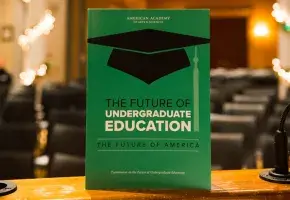
Major study by American Academy of Arts and Sciences seeks change in curriculum and assessment, commitment to funding public higher education, new ideas about the faculty role, and more.
"Science During Crisis" coauthors Rita Colwell and Gary Machlis show how science plays a critical role in responding to crises, informing and guiding decisions governing disaster response and recovery.
John G. Levi discusses access to justice, and how many low-income Americans have significant difficulty navigating our country’s legal system on their own.
The Academy hosted a meeting at the University of Chicago on the benefits and risks of nuclear, biological, and information technologies. The speakers included Robert Rosner, James M. Acton, Elisa D. Harris, and Herbert Lin.
On December 4, 2015, at the Georgetown University Law Center, the Academy hosted a panel discussion on “The Crisis in Legal Education” with Louis Michael Seidman, Robert A. Katzmann, Philip G. Schrag, Robin L. West, and Patricia D. White.
Danielle Allen, cochair of Academy project on the Practice of Democratic Citizenship, says students need to understand government just as much as math and science.
A growing numbers of parents are either delaying or selectively administering immunizations – or choosing not to vaccinate their children at all. A new Academy report makes clear that reversing this trend requires dedicated research on how vaccine decisions are made and the best ways to communicate factual information to vaccine-hesitant parents.
As part of the 2013 Induction weekend, Ken Burns (President of Florentine Films) and Ernest J. Moniz (U.S. Secretary of Energy) spoke about the challenges and opportunities for the arts and the sciences.
Academy members and guests attended a matinee performance of Robert Glaudini's The Poison Tree, in its world premiere at the Mark Taper Forum. After the show, they adjourned to the Dorothy Chandler Pavilion for dinner and the Stated Meeting, presided over by Western Center Cochair Jack W. Peltason.