A poll sponsored by the Academy, and conducted by the Center for Public Opinion at UMass-Lowell, reveals displeasure with the state of American politics and receptivity to changes in how we elect Congressional representatives.
On October 11, 2014, the American Academy inducted its 234th class of Fellows and Foreign Honorary Members. The ceremony included presentations by new Fellows Ramamurti Shankar, Diana H. Wall, Sherry Turkle, Mary Kelley, and John W. Rogers, Jr.
Civil wars can give rise to major threats to international stability, including transnational terrorism, pandemics, mass migration and refugee flows, and regional instability. Particularly serious concerns include the ways that civil conflict can contribute to the emergence of infectious diseases, undermine efforts to respond to pandemics – such as through vaccine distribution – and generate transnational terrorism with a global reach.
On January 25, 2013,Thomas Levy described “cyber-archaeology” and the important role it plays in helping to promote excellence in the humanities and social sciences.
Anti-intellectualism is on the rise, fueled in part by attacks on institutions of higher education. As a result, the public has begun to question the role these institutions play in society and whether they still provide the value they once did. For decades, colleges and universities have claimed to advance the public good, pointing to their research contributions as evidence of their value and their continued need for public support. Their internal processes, however, do not always reflect their commitments.
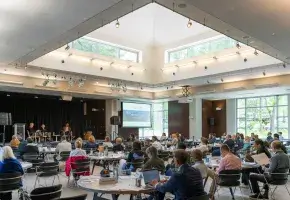
Higher education leadership was the focus of the Academy’s annual convening of The Higher Education Forum in June 2025. More than one hundred higher education experts and leaders, including university presidents, provosts, and deans from many of the Academy’s Affiliates as well as several Academy members, engaged in an array of topics.
Academy members and guests attended a matinee performance of Robert Glaudini's The Poison Tree, in its world premiere at the Mark Taper Forum. After the show, they adjourned to the Dorothy Chandler Pavilion for dinner and the Stated Meeting, presided over by Western Center Cochair Jack W. Peltason.
Mark S. Schlissel, Mary Sue Coleman, Patrick Doyle, M. Roy Wilson, and Lou Anna K. Simon participated in a discussion at the University of Michigan about public research universities and their role in serving the public interest in Michigan.
Lassina Zerbo, Rose E. Gottemoeller, Siegfried Hecker, and Robert Rosner participated in a discussion on the prospects for ratifying the Comprehensive Nuclear-Test-Ban Treaty and the challenges presented by nuclear testing.
The closing program of the Academy’s 2024 Induction weekend featured a presentation by new member André Fenton about the science and stimuli of memory, followed by a conversation with incoming Academy President Laurie L. Patton. An edited transcript of the presentation and conversation follows.
Historian Bernard Bailyn opened the celebration of the 220th annual meeting of the Academy with a commentary on the personal characteristics of John Adams as revealed in his diary and his autobiography.