Utility navigation

  • Dædalus
  • Archives
  • Give
  • Login

Main navigation

  • Our Work
    • Explore by Topic
      • Arts & Humanities
      • Democracy & Justice
      • Education
      • Energy & Environment
      • Global Affairs
      • Science & Technology
    • View
      • Projects
      • Publications
  • Members
  • News
  • Events
  • Get Involved
  • About

Main navigation

  • Our Work
    • Explore by Topic
      • Arts & Humanities
      • Democracy & Justice
      • Education
      • Energy & Environment
      • Global Affairs
      • Science & Technology
    • View
      • Projects
      • Publications
  • Members
    • Member Directory
    • Magazine: The Bulletin
    • Local Committees
  • News
  • Events
  • Get Involved
  • About
    • Governance
      • Board of Directors
      • Council
      • Trust
      • Committees
      • President
    • Staff
    • Affiliates
    • Prizes
      • Amory
      • Distinguished Leadership
      • Don M. Randel Humanistic Studies
      • Emerson-Thoreau
      • Excellence in Public Policy
      • Founders
      • Rumford
      • Sarton History of Science
      • Sarton Poetry
      • Scholar-Patriot
      • Talcott Parsons
    • Fellowships
    • Location
    • History
    • Advisors
      • Education
      • The Humanities, Arts, and Culture
      • Science, Engineering, and Technology

Footer

  • Daedalus
  • Login
  • Archives
  • Give
  • Careers
  • Contact
  • Private Events

136 Irving Street
Cambridge, MA 02138

Social Media

  • Facebook
  • LinkedIn
  • YouTube
Search results for

“WA”

Search

  • All (22580)
  • Events (371)
  • (-) News (1934)
  • People (17906)
  • Projects (145)
  • Publications (2224)
Data Forum
|
Aug 18, 2014

Who Takes Humanities Courses in College?

Compared with our knowledge about students who take courses in the sciences, we know very little about who takes humanities courses in college. With the sciences, most of what we know is about majors rather than courses taken because data on majors are more readily available. Therefore having basic information about relative course-taking by students who majored in particular subjects is extremely important.
Data Forum
|
Aug 18, 2014

Toward Breadth in Baccalaureate Education

Those of us who teach undergraduates are familiar with the trend revealed in these data. Baccalaureate graduates typically have earned more course credits in the humanities (about 17% as defined here) than in STEM fields (about 13%). STEM majors earn fewer credits in the humanities than do students majoring in other areas; and students majoring in the humanities, business, social sciences, and education apparently earn no more than a required minimum of their credits in STEM courses.
Academy Article
|
Jul 15, 2019

New Evidence on Waning American Reading Habits

The American Academy's Humanities Indicators project provides new indicators on Americans' dwindling engagement with books, the types of texts they are reading, changing attitudes about censorship, and student reading proficiency.
In the News
|
Jul 9, 2019

Science and Tech in an Age of Anxiety

A new study from the Academy's project on the Public Face of Science analyzes public optimism and reservations about science and technology across 54 countries and 81,000 people.
Source
Medium
Paul Wise treating a child in a rural village in Guatemala
In the News
|
Jul 23, 2019

Paul Wise heads up global initiative to boost humanitarian health response to violent conflict

Paul Wise will cochair the latest Academy project on “Rethinking the Humanitarian Health Response to Violent Conflict,” designed to help define new strategies for the provision of essential health services in areas of violent conflict.
Source
Stanford CHP News
BULLETIN ISSUE

Summer 2019 Bulletin

Bulletin
|
Aug 7, 2019

From the President

One of the great strengths of the Academy is its ability to bring together members with other experts from many disciplines and professions to explore contemporary challenges, identify solutions, and offer ways forward to advance the public good.
Bulletin
|
Aug 7, 2019

New Academy Report on Science During Crisis: Why Does it Matter?

Weather and climate disasters – along with natural hazards, such as earthquakes, public health crises, and human-caused contaminant spills – threaten human lives and pose challenges to relief efforts, to the restoration of ecosystems, and to the rebuilding of communities. Science plays an important role in response and recovery and can contribute immensely to disaster prevention.
Bulletin
|
Aug 7, 2019

Water in Our Future

On June 19–20, 2019, the Academy convened an Exploratory Meeting in Boston, MA, on “Water in Our Future.” The participants included water program officials, water policy experts, research scientists, and scholars in the humanities and sciences from the United States and around the world. The meeting was organized to help identify key questions related to water security and to inform how a potential Academy project might make a contribution in this area.
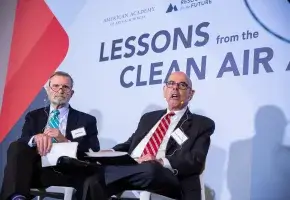
Former Representatives Phil Sharp and Henry Waxman discuss climate and energy policy
Bulletin
|
Aug 7, 2019

Lessons from the Clean Air Act: Building Durability and Adaptability into U.S. Climate and Energy Policy

Over five decades, the Clean Air Act has become a venerable, living institution that has been highly successful in improving the environment around the country. Its success results from its durability and flexibility, two concepts that often seem to be in opposition yet may be essential to establishing successful climate and energy policy.
Bulletin
|
Aug 7, 2019

Dædalus Explores Processes of Inequality

Rising inequality is one of our most pressing social concerns. And it is not simply that some are advantaged while others are not, but that structures of inequality are self-reinforcing and cumulative; they become durable. The societal arrangements that in the past have produced more equal economic outcomes and social opportunities – such as expanded mass education, access to social citizenship and its benefits, and wealth redistribution – have often been attenuated and supplanted by processes that are instead inequality-inducing.
Bulletin
|
Aug 7, 2019

Member Policies

Like many other organizations, the Academy has been reviewing its policies related to members accused of crimes or other inappropriate actions (e.g., sexual harassment, falsification of research results, intentional plagiarism, and other breaches in professional ethics or academic misconduct). While the Academy’s 1780 charter and the current bylaws provide for expelling or disenfranchising members for cause, there is no record that the Academy has taken any action related to expelling a member nor any policy to guide the practice.
Bulletin
|
Aug 7, 2019

Noteworthy

Select Prizes and Awards to Members
Bulletin
|
Aug 7, 2019

Morton L. Mandel Public Lecture: A Conversation about Frederick Douglass

On April 1, 2019, the American Academy and the Whitney and Betty MacMillan Center for International and Area Studies at Yale presented their first joint public program, which featured a conversation between David Blight and Robert Stepto. The program, which served as the Academy’s Morton L. Mandel Public Lecture, included a welcome from Ian Shapiro. Crystal Feimster moderated the program.
Bulletin
|
Aug 7, 2019

The Rumford Prize: Acceptance Remarks by Edward Boyden

On April 11, 2019, the American Academy of Arts and Sciences presented the Rumford Prize to six scientists for the invention and refinement of optogenetics. The awardees are Ernst Bamberg, Professor and Director of the Department of Biophysical Chemistry at Max-Planck Institute of Biophysics; Edward Boyden, Y. Eva Tan Professor of Neurotechnology, Associate Professor of Biological Engineering and Brain and Cognitive Sciences at MIT’s Media Lab and McGovern Institute for Brain Research, and Co-Director of the MIT Center for Neurobiological Engineering; Peter Hegemann, Professor and Head of the Department for Biophysics at Humboldt University of Berlin; Gero Miesenböck, Waynflete Professor of Physiology and Director of the Center for Neural Circuits and Behavior at the University of Oxford; Georg Nagel, Professor at the University of Wuerzburg (Bavaria); and Karl Deisseroth, D. H. Chen Professor of Bioengineering and of Psychiatry and Behavioral Sciences at Stanford University. Lucia Rothman-Denes, A. J. Carlson Professor of Molecular Genetics and Cell Biology at the University of Chicago, introduced the prize recipients and presented the award. Edward Boyden accepted the award on behalf of all the prize recipients. An edited version of his acceptance remarks appears below.

Bulletin
|
Aug 7, 2019

Award for Excellence in Public Policy and Public Affairs: Acceptance Remarks by Ernest J. Moniz

On April 11, 2019, the American Academy of Arts and Sciences presented the inaugural Award for Excellence in Public Policy and Public Affairs to Ernest J. Moniz, the 13th Secretary of Energy of the United States. Ashton Carter, who served as the 25th Secretary of Defense of the United States and is the current Director of the Belfer Center for Science and International Affairs at Harvard Kennedy School, introduced Secretary Moniz and presented the award. An edited version of Secretary Moniz’s acceptance remarks appears below.
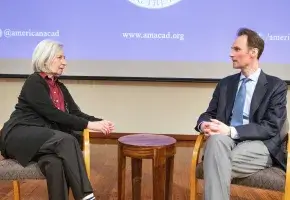
Martha Minow and John Palfrey discuss the intersection between a growing commitment to diversity, equity, and inclusion and the tradition of free expression on school campuses.
Bulletin
|
Aug 7, 2019

Safe Spaces, Brave Spaces: Diversity and Free Expression in Education

On May 7, 2019, John Palfrey spoke about the intersection between a growing commitment to diversity, equity, and inclusion and the tradition of free expression on school campuses. Martha Minow participated in a conversation with John Palfrey following his opening remarks.
Museum and Visitors
Academy Article
|
Aug 12, 2019

Visits to Historic Sites and Museums on the Rise

In updates released this morning, the American Academy's Humanities Indicators report that visits to historic sites, museums, and art galleries are on the rise in recent years.
Bulletin
|
Jan 1, 2009

New Fellows Reflect on Membership in the Academy

New members arrived at the House of the Academy in a state of anticipation, awaiting the morning orientation. Many vividly described the moment that news
of their election arrived.
Bulletin
|
Jan 1, 2009

Humanities Indicators Prototype Launched

In 2002, the Academy’s Initiative on Humanities and Culture issued its first Occasional Paper, Making the Humanities Count–a study of the need for a systematic and sustained effort to collect data on the state of the humanities in the United States. The Academy took up the challenge, and on January 7, 2009, it launched a prototype set of statistics: the Humanities Indicators.

Pagination

  • Previous page ←
  • 59 of 97
  • Next page →

136 Irving Street
Cambridge, MA 02138

617-576-5000

VEHICLE ENTRANCE

200 Beacon Street
Somerville, MA 02143

Main navigation

  • Our Work
  • Members
  • News
  • Events
  • Get Involved
  • About

Footer

  • Daedalus
  • Login
  • Archives
  • Give
  • Careers
  • Contact
  • Private Events

Social Media

  • Facebook
  • LinkedIn
  • YouTube
© 2026

American Academy of Arts & Sciences  |  Web Policy