Peter Michael Nicholas, elected to the American Academy of Arts and Sciences in 1999, died two days before his 81st birthday at his home in Boca Grande, Florida.
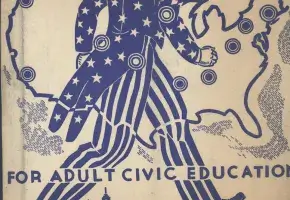
One of the recommendations for strengthening American democracy proposed in Our Common Purpose - the report of a bipartisan Academy commission - is to invest in civic education programs and professional development opportunities for educators in all communities. This article examines legislative progress at the federal, state, and local levels concerning civics education.
In January I had the opportunity to travel to London to participate in the continuation of one of the Academy’s longest institutional relationships: our shared pursuit of knowledge with the Royal Society, the oldest scientific society in existence. The first interaction between our two societies occurred in 1785, when Royal Society member Benjamin Gale contributed to the first volume of the Academy’s Memoirs. A few years later, in 1788, Royal Society President Sir Joseph Banks was elected a Foreign Honorary Member of the Academy.
As of January, less than half of Americans made intentional use of artificial intelligence tools (AI) to perform a variety of common tasks, but a substantial minority used AI for humanities-related tasks.
Academy President Laurie Patton shares her experience at the Higher Education Forum and how a diverse group of leaders - with an array of divergent viewpoints - answered the question “Is higher education leadership possible?”
How do we counter implicit bias in its individual and systemic manifestations? This question is explored in the Winter 2024 issue of Dædalus by leading scholars, scientists, and policymakers who examine the science behind implicit bias—the residue of stereotyped associations and social patterns that exists outside our conscious awareness but reinforces inequality in the world.
The American Academy of Arts and Sciences was founded by visionaries who foresaw that the nascent republic would benefit from the expertise of learned citizens to guide its development, health, and integrity through any challenges that may arise.
While the scientific community understands the benefits of international scientific collaboration, risks of such collaboration to U.S. national security are now at the forefront of debate. Terry Magnuson examines the recommendations offered in “America and the International Future of Science,” a report from the Academy’s initiative to address Challenges for International Scientific Partnerships.
Public libraries and their grounded, portable and invisible civic infrastructure give us another, better way to relate to ourselves and to each other — not only as consumers, but as citizens.
A new report from the Commission on the Arts - Art for Life’s Sake: The Case for Arts Education - sets forth recommendations to reverse the persistent decline in access to arts education in America. The report offers local, state, and national elected leaders recommendations in six areas, including elevating the arts, ensuring equitable access, and supporting educators.
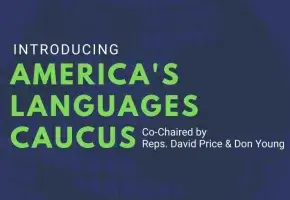
Inspired by the Academy report on "America's Languages," Congressmen David Price (D-NC) and Don Young (R-AK) announced the creation of the Congressional Caucus on American Languages, a bipartisan effort to support and enhance foreign language competency and international education in the U.S.
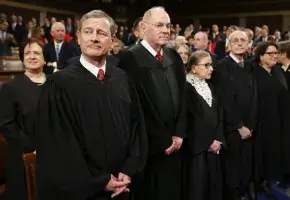
Authors Stephen B. Heintz and Pete Peterson, coming from different sides of the political aisle, agree that term limits for Supreme Court Justices is a way to depoliticize the process and strengthen faith in democratic institutions.
Building on America’s 250-year-old commitment to knowledge, the American Academy of Arts & Sciences announces the leaders in academia, the arts, industry, journalism, philanthropy, policy, research, and science elected in 2026.