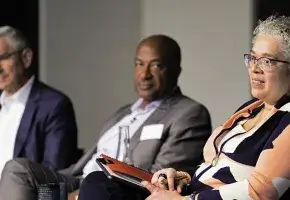
The Academy’s second annual convening of The Higher Education Forum was held in Aspen, CO, in June 2023. More than one hundred higher education experts and leaders, including university presidents, provosts, and deans from many of the Academy’s Affiliate institutions as well as several Academy members, engaged in an array of topics.
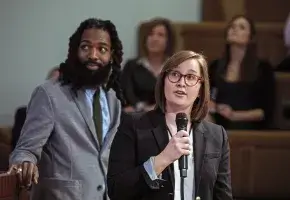
In early February, the Academy welcomed Americans from around the nation for a day-long convening on the practice of democratic citizenship. The event was a culmination of the extensive grassroots outreach and listening sessions that have been a hallmark of the work of the Academy’s Commission on the Practice of Democratic Citizenship.
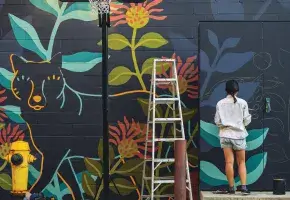
The Commission on the Arts is the Academy’s first major programmatic effort focused on the arts and culture. At its center is the belief that the arts are essential to both individual and civic life and that artists are crucial to the functioning and development of healthy communities.
Academy members and guests attended a matinee performance of Robert Glaudini's The Poison Tree, in its world premiere at the Mark Taper Forum. After the show, they adjourned to the Dorothy Chandler Pavilion for dinner and the Stated Meeting, presided over by Western Center Cochair Jack W. Peltason.
As part of the 2013 Induction weekend, Ken Burns (President of Florentine Films) and Ernest J. Moniz (U.S. Secretary of Energy) spoke about the challenges and opportunities for the arts and the sciences.
Librarian of the Congress James H. Billington, historian and scholar John Hope Franklin, and former Supreme Court Justice Sandra Day O’Connor will receive the Public Good Award from the two organizations in recognition of their significant contributions to the advancement of learning and knowledge.
A decade has passed since the publication of The Heart of the Matter, the influential report on the value of the humanities by the Academy’s Commission on the Humanities and Social Sciences. What has happened to the humanities over the past ten years, and what might we do to better support the humanities in the future?
The 2111th Stated Meeting featured remarks from Danielle Allen, a member of the Commission that authored The Heart of the Matter, who reflected on the humanities as a historical and contemporary practice in an age of digital superabundance. The meeting also included a conversation between Allen and arts correspondent Jeffrey Brown about the practical applications for the humanities, what works and what doesn’t for asserting their value, and their role in contemporary political debates and culture wars. Academy President David W. Oxtoby offered introductory remarks. An edited version of the presentations and discussion follows.
There was a time before strong leaders, social inequality, and class systems. Coming of age in the 1960s, my motivation was to understand and hopefully help alter the world of unjust and unstable societies. This personal essay summarizes my career as an archaeologist studying the emergence of complex political systems.
Building on America’s 250-year-old commitment to knowledge, the American Academy of Arts & Sciences announces the leaders in academia, the arts, industry, journalism, philanthropy, policy, research, and science elected in 2026.
Greetings from Cambridge, Massachusetts, where earlier this fall the Academy celebrated its first in-person Induction weekend since 2019. We welcomed new members from the classes of 2020 and 2021 with an opening celebration featuring Yo-Yo Ma in conversation with David Rubenstein at Harvard Business School’s Klarman Hall. On the following day, new members gathered with governance members, project leaders, and Academy staff for a lively open house at the Academy’s headquarters in Norton’s Woods. Later that afternoon, the two classes of inductees gathered at MIT’s Kresge Auditorium for a resumption of the moving Induction Ceremony that we have all missed for so long.