Though technology and warfare have greatly evolved since Michael Walzer published his seminal text Just and Unjust Wars over forty years ago, the debate on the ethical challenges posed by these changes has been confined mostly within the boundaries of specific disciplines; few attempts have been made to pursue a genuine interdisciplinary debate on this matter.
Learning to cope with the transitory nature of information storage and transmission will eventually become a normal feature of
twenty-first-century scholarship. In the worst cases, one wrong click of a mouse button and weeks of research, years of written text, and decades of preservation can be undermined, effectively making the written word as transitory as the spoken one.
The Humanities Indicators project recently released a series of reports on the life cycle of doctoral degree recipients in every field, shedding light on the challenges involved in earning the degree, and the occupational outcomes and incomes of those with a Ph.D.
The American Academy inducted its 236th class of members at a ceremony that included presentations by five new members: Terry A. Plank, Jay D Keasling, Andrea Louise Campbell, Theaster Gates, Jr., and Walter Isaacson.
Temple Grandin discussed the education of students who have different kinds of minds, as well as her own upbringing and work experience as a woman with autism.
Two days after the election of Donald Trump as the forty-fifth president of the United States, Charles Stewart III, Lawrence D. Bobo, and Jennifer L. Hochschild discussed “Populism and the Future of American Politics.”
On November 15, 2016, the Academy’s San Diego Program Committee hosted Veerabhadran Ramanathan and David G. Victor for a discussion on the state of scientific understanding of climate change and the implications of this knowledge for the development of future policy.
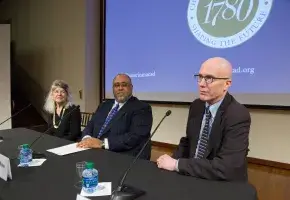
Scott D. Sagan, Joseph H. Felter, and Paul H. Wise discussed “A Collective Moral Awakening: Ethical Choices in War and Peace,” which is, in part, the subject of the Winter 2017 issue of Dædalus.
Academy member Denis Feeney has spent the last few years trying to understand why the Romans developed a literature in their Latin language, when the balance of historical probability was against this happening.
In 1980, I began my fellowship in pediatric infectious diseases at the Children’s Hospital of Philadelphia. My mentor was Dr. Stanley Plotkin: the inventor of the RA27/3 strain of rubella vaccine – the one that by 2005 had eliminated the disease from the United States.
Why has China, for so much of its history, been the most populous country in the world? How were the states that were formed in China able to rule larger territories and populations and maintain centralized structures longer than governments elsewhere?
It is with profound sadness that the Academy notes the death of former Academy President Leo L. Beranek on October 10, 2016, at age 102. Dr. Beranek served as President from 1989 to 1994. He was an active and devoted member of the Academy.
With generous support from Carnegie Corporation of New York, the Commission on the Future of Undergraduate Education is conducting an analysis of American undergraduate education and looking ahead several decades at the educational challenges and opportunities facing Americans.