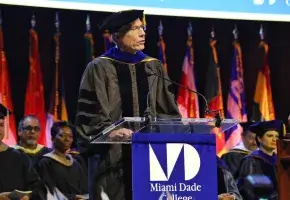
Michelle Weise, member of the Academy's Commission on the Future of Undergraduate Education, explores the 'black box' of college outcomes facing education consumers.
“Access to Justice,” the Winter 2019 issue of Dædalus, the Journal of the American Academy of Arts & Sciences, is a multidisciplinary exploration of the challenges, costs, and opportunities related to the crisis of limited civil legal services.
The Chronicle interviewed Michael S. McPherson, cochair of the Commission on the Future of Undergraduate Education, to hear about improving educational quality, raising completion rates, reducing inequality, and making college more affordable.
One of the great strengths of the Academy is its ability to bring together members with other experts from many disciplines and professions to explore contemporary challenges, identify solutions, and offer ways forward to advance the public good.
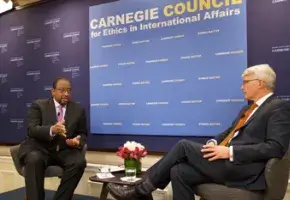
Scott Sagan discusses the nuclear necessity principle and Academy project on ethics, technology, and war with Randall Pinkston of Carnegie Council for Ethics in International Affairs.
Danielle Allen, cochair of the Academy's Commission on the Practice of Democratic Citizenship, writes in the Washington Post that "There is something we can do" to move the nation toward a better normal - and peace.
Learn about the Academy event -- "What are the Challenges and Opportunities of AI in Mental Health Care?" -- which brought together members of the Academy’s AI and Mental Healthcare project to discuss what they learned and the publication they released.
Communities with strong civic infrastructure engender greater civic engagement and a sense of belonging. Stephen Heintz, cochair of the American Academy’s Commission on the Practice of Democratic Citizenship, argues that philanthropy should lead in funding projects across the country that would connect people to their neighbors, communities, and government institutions.
In my previous message, I discussed how – despite the challenges of the pandemic – our community of members has remained active and engaged in the life of the Academy. During the past year, our virtual events reached more audiences in more places than ever before. Our project work continued unabated, including the release of Our Common Purpose: Reinventing American Democracy for the 21st Century and the development of new major projects on climate change and inequality. And despite great uncertainty, our members came together to produce a record-breaking fundraising year.
On February 4, 2015, Andrea Roth and Franklin Zimring participated in a conversation at the University of California, Berkeley, on police use of lethal force against civilians.
It is my pleasure to present this edition of the Annual Report of the American Academy of Arts and Sciences, the first since I officially began my term as president in January 2025. I would like to begin by expressing my sincere gratitude to the hundreds of members whom I have had the opportunity to meet and learn from this year.
A lively look at the importance of civics education, teaching the Constitution, and the responsibility of stewarding America, featuring a keynote address by NEH Chairman William “Bro” Adams
The Winter 2022 issue of Daedalus, "Creating a New Moral Political Economy," explores what it would take to develop an economy that promotes more equal footing across the polity, marketplace, and workplace. Daedalus is an open access publication and all 11 essays and 22 responses are online.
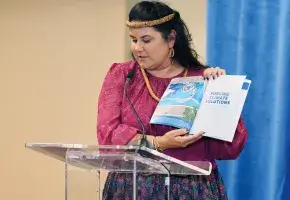
On October 24, 2023, the Academy released Forging Climate Solutions: How to Accelerate Action Across America, the final report of the Commission on Accelerating Climate Action. Prompted by a statement by the Academy’s Board in 2021, the report addresses the need for a climate strategy that breaks through the divisions that characterize politics in the nation today.
A poll sponsored by the Academy, and conducted by the Center for Public Opinion at UMass-Lowell, reveals displeasure with the state of American politics and receptivity to changes in how we elect Congressional representatives.